Legends of Tono
Legends of Tono
Couldn't load pickup availability
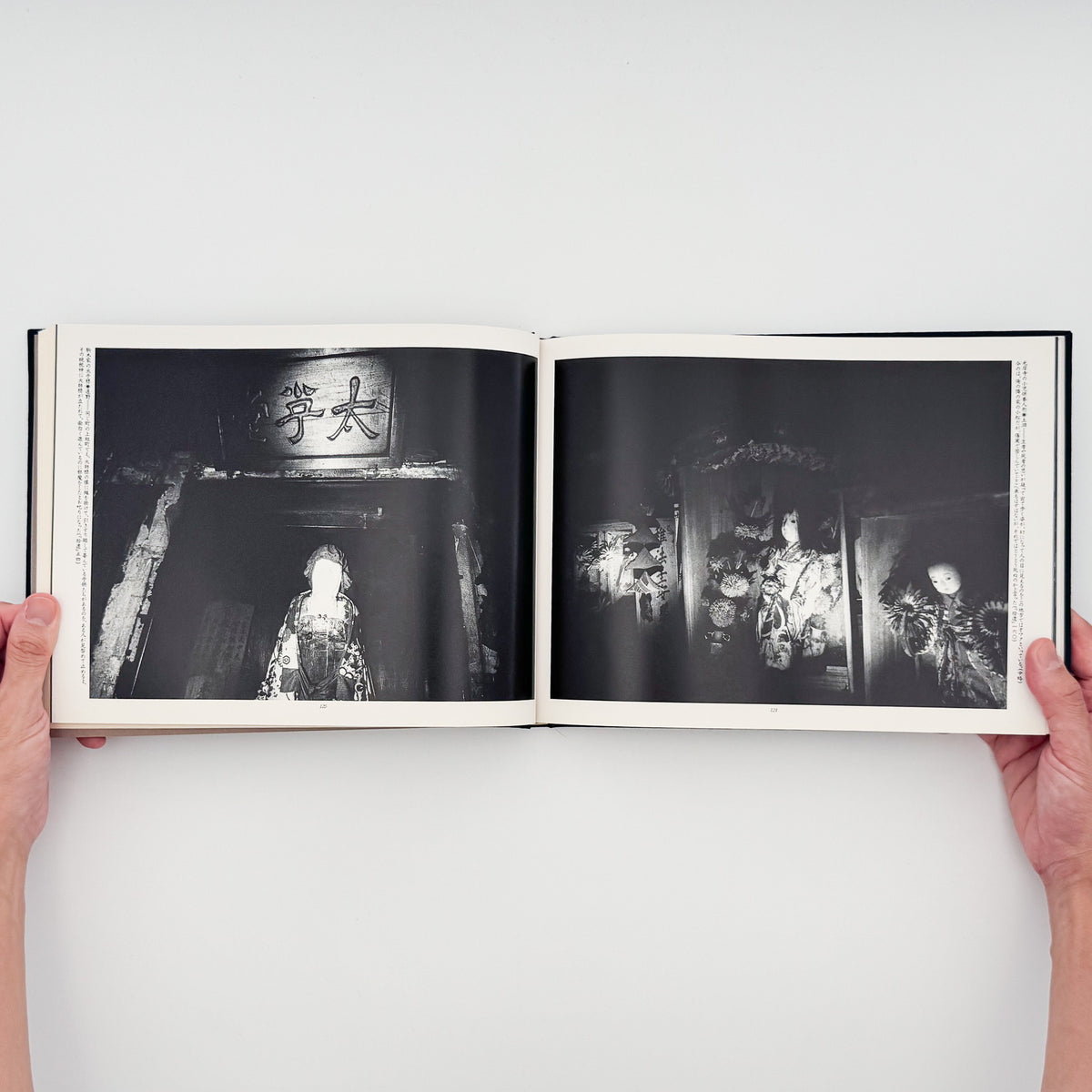
A photo book by photographer and folklorist Masatoshi Naito, “Tono Monogatari.” Published by Shunkyusha in 1983, this collection was inspired by Kunio Yanagita’s “Tono Monogatari” and features photographs of the landscapes, folk beliefs, and local customs of the Tono region in Iwate Prefecture. It primarily comprises photographs taken between 1971 and 1975, supplemented with newer works.
Naito first visited Tono in the fall of 1971, experimenting with strobe flashes to bring people, landscapes, and objects of worship into relief against the darkness of night. Through portraits and photographs of the deceased displayed in mountain temples, the deities enshrined throughout the land, and the people living in Tono, he overlays everyday scenes with the folkloric world that lies beneath.
The book is divided into three parts: “The Living,” “The Dead,” and “The Deities.” Drawing on the legends of mountain dwellers recorded in Kunio Yanagita’s “Tono Monogatari” and the beliefs surrounding the mountains that encompass Tono, Naito also examines the history of metalworkers, such as gold miners and tatara ironmakers, who once lived migratory lives in the mountains. The work combines Naito’s concept of “metal folklore” with photographic expression.
The back of the book includes “A Separate Study of ‘Tono Monogatari’” by Takaaki Yoshimoto and Naito’s own “Tono Monogatari Notes.” Yoshimoto interprets the “mountain dwellers” described by Yanagita through the lens of village communities and occupational groups, while Naito examines the legends and metal culture of Tono based on his photography and fieldwork.
Through photographs taken in Tono during the 1970s and folkloric research, this volume captures a world where life and death, belief, and local history intersect. It is a representative photo book of Masatoshi Naito’s career-long pursuit of the spiritual culture of the Tohoku region, alongside works such as “Dewasanzan.”
[Title] Masatoshi Naito Photo Book, Tono Monogatari
[Publisher] Shunkyusha
[Publication Date] June 10, 1983 (First Edition)
[Pages] 152 pages
[Size] Approx. 224 × 294 × 24 mm / 1170 g
[Format] Hardcover, cloth binding, slipcase
[Language] Japanese
[Title Reading] Naito Masatoshi Shashinshu Tono Monogatari
[Author/Editor/Etc.] Masatoshi Naito/Photography and text; Takaaki Yoshimoto/Commentary; Akira Hasegawa/Photo arrangement; Kazuyuki Goto/Book design
[Printing/Binding] Mitsumura Genshoku Printing Co./Printing; Kobayashi Binding Co./Binding
[ISBN] 4393953071
[Condition] Used [7] Good (Dust jacket: minor stains, minor fading, minor repaired tears; minor scuffs on slipcase)
[Accessories] Slipcase (slipcase lid missing), dust jacket
[Featured In] -
[Related Exhibitions] -
Masatoshi Naito (Naito Masatoshi) 1938–2025
Born in Tokyo in 1938. Photographer and folklorist. Graduated from the Department of Applied Chemistry at Waseda University’s Faculty of Science and Engineering in 1961. After working at Kurashiki Rayon, he began working as a freelance photographer.
From the 1960s, he focused on photographing folk beliefs in the Tohoku region and religious culture throughout Japan. He published works such as “Japanese Mummies” and “Bakuhatsu! The Old Woman!” and continued to document jishinbutsu, shugendo, rituals, and beliefs concerning the deceased.
From 1971, he photographed the Tono region in Iwate Prefecture and explored the legends of mountain dwellers and metal culture through Kunio Yanagita’s “Tono Monogatari.” He conducted folkloric research and published “Kikigaki Tono Monogatari” in 1978 and the photo book “Tono Monogatari” in 1983.
He is known for his distinctive style of actively using strobes to bring figures and landscapes into relief from the darkness. Through photography, he documented the visible world while also interpreting the beliefs and history accumulated in the land through folkloric research.
In 1983, he received the Second Ken Dobun Award. His major photo books include “Oba: Folk Beliefs of Tohoku” (1979), “Dewasanzan” (1980), “Tono Monogatari” (1983), and “Tokyo: Visions of the Urban Darkness” (1985).
Died July 9, 2025.
< Related Figures >
Masatoshi Naito
Kunio Yanagita
Kizen Sasaki
Takaaki Yoshimoto
Higashimatsu Lighting
Akira Hasegawa
Shunkyusha


You may also like
-
Masatoshi Naito: Another World Unveiled
Vendor:内藤正敏 / NAITO MasatoshiRegular price ¥7,000Regular price -
Masatoshi Naito Photo Collection: Minobu-san and Shichimen-zan - Sacred Sites of the Lotus Sutra Faith
Vendor:内藤正敏 / NAITO MasatoshiRegular price ¥4,700Regular price -
TOKYO: Visions of the City's Darkness, 1970–1985
Vendor:内藤正敏 / NAITO MasatoshiRegular price ¥24,000Regular price -
Asahi Camera July Special Issue: Viewing the City
Vendor:アサヒカメラ / ASAHI CameraRegular price ¥3,500Regular price -
Works By 25 Photographers in Their 20s Young Portfolio
Vendor:清里フォトアートミュージアム / KIYOSATO MUSEUM OF PHOTOGRAPHIC ARTSRegular price ¥1,100Regular price¥2,000Sale price ¥1,100Sold out