Japanese Folk Tools, Volume 2: Rural Life
Japanese Folk Tools, Volume 2: Rural Life
Couldn't load pickup availability
This series was published to commemorate the achievements of folklorist Keizo Shibusawa.
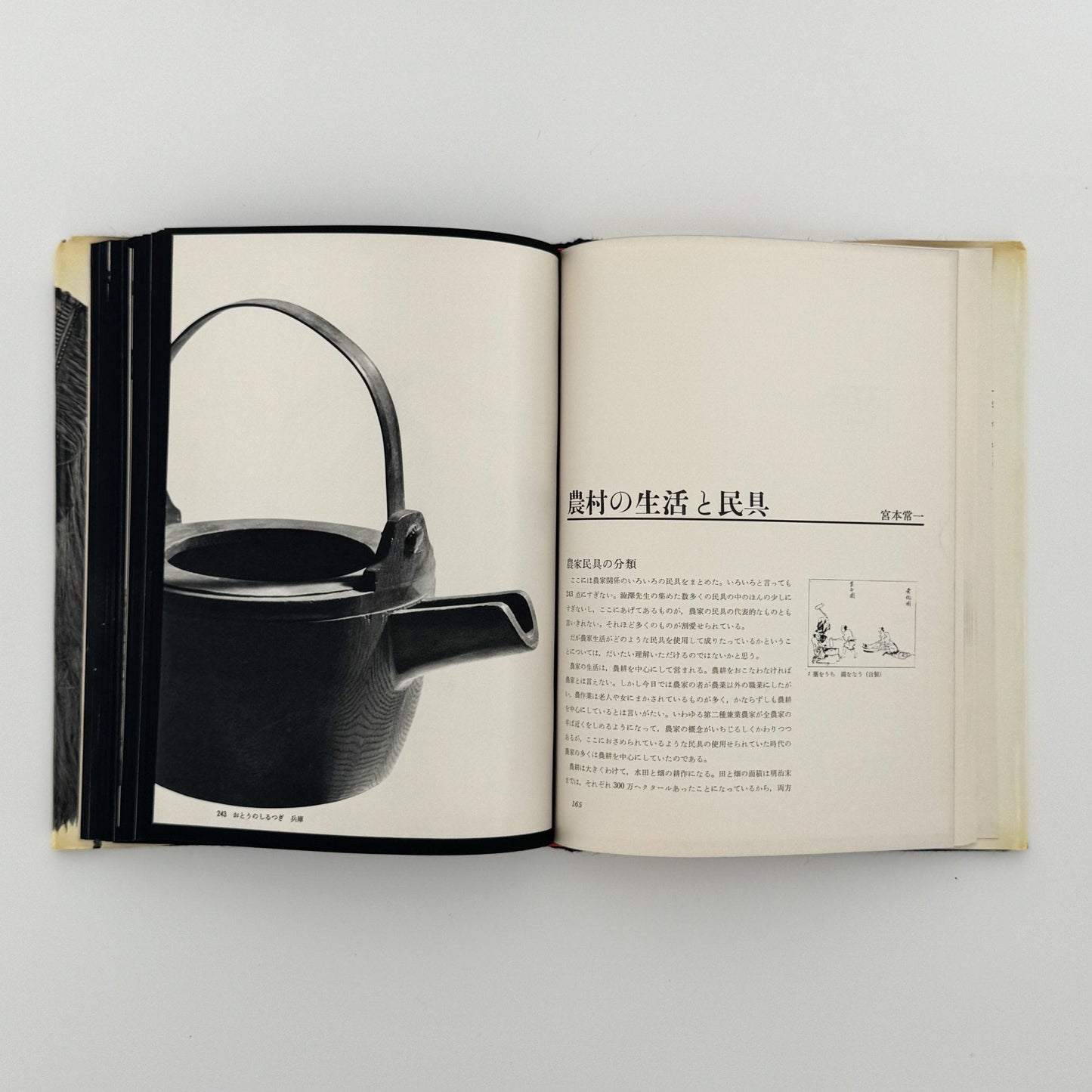
This volume introduces the diverse folk tools passed down in Japanese farming villages, with precise photographs and detailed explanations. It is a valuable resource that records and preserves vanishing folk culture, including agricultural tools, implements rooted in daily life, and tools that supported their activities.
This is a culmination of the study of folk tools that Keizo Shibusawa dedicated his life to collecting and researching, making it an essential resource for those interested in folklore, history, and cultural property research.
Gravure printing was used for the printing, characterized by a deep monochrome reproduction.
It fully expresses the texture and weight of the folk tools, going beyond mere documentary photographs to bring out their sculptural beauty.
[Title] Commemorative Publication for the Late Professor Keizo Shibusawa: Folk Tools of Japan, Volume 2: Farming Villages, Keiyusha Edition
[Publisher] Keiyusha
[Publication Date] August 10, 1965 (Showa 40)
[Page Count] 206 pages
[Size] Outer dimensions approx. 30.4 x 22.4 x 3.3 cm, 1.51 kg
[Format] Hardcover
[Title Reading] SHIBUSAWA KEIZO SENSEI TSUI TO KINEN SHUPPAN NIHON NO MINGU DAINIKAN NOSON KEIYUSHA BAN
[Author/Editor, etc.] Isamu Isogai, Katsunori Sakurada/Author, Kiyoshi Sonobe/Photography, Seiichi Tagawa/Book Design and Layout
[Printing] Gravure Seikosha, Chuo Seihan Insatsu/Printing, Matsumoto Seihonsho/Binding
[ISBN] None
[Condition] Used [3] Fairly Poor (Overall age-related tanning, slipcase damaged/slightly stained, cover damaged, main body relatively good)
[Accessories] Slipcase
[Featured in]
[Related Exhibitions]
Isamu Isogai (1905- ? (under confirmation))
Born in Hiroshima City, Hiroshima Prefecture in 1905.
After graduating from Kobe Higher Technical School, Department of Mechanical Engineering, he engaged in industrial education while also joining the Attic Museum (Japan Center for Folk Culture Research) led by Keizo Shibusawa, where he dedicated himself to the study of folk tools.
Katsunori Sakurada (1903- ? (under confirmation))
Born in Sendai City, Miyagi Prefecture in 1903.
Graduated from Keio University with a degree in History. In 1935, he became a member of the Attic Museum, primarily conducting research on farmers. In 1955, he mainly conducted research on fishing villages.
In 1955, he was appointed Director of the Fishery Agency's Fishery Material Museum.
His major works include "Fisherman's Folklore" (Isseisha) and "Fisherman" (Rokuninsha).
Kiyoshi Sonobe 1921–1996
Born in Tsukudajima, Tokyo in 1921.
Joined Tohosha in 1943 and studied under Ihei Kimura.
After the war, he worked for Sun News Photos and Iwanami Productions, and also participated in the photography for "Iwanami Shashin Bunko."
After becoming independent in 1957, he traveled throughout Japan, documenting daily life, cultural traditions, and local customs.
Known for works such as "Kitakami River" and "Lost Landscapes of Japan," he also received the Photographic Society of Japan Award.
Throughout his life, he continued to photograph Japan's original landscapes and folk and local cultures.